"SODON" COVERS ANYTHING RELATED TO MONGOLIA

Sunday, March 16, 2014

The Mongol gene

Most legendary Mongol wrestler Bayanmunkh Kh.
It happened to me at least twice,  greeted with a  very friendly attitude,   Koreans declared me as a "close relative"  of theirs. By blood and origin. A slightly drunken native American (wrongfully called also as American Indian) approached me once and while holding his bare arm to mine's, said, "Aren't we brothers? Look at our arms; don't they look the same?", meaning the matching skin colors. Kazakhs say that Chinggis Khan (or Genghis Khan if you will) was a Kazakh and therefore they deserve some credit in regards to his fame and name he made in the world history. So, in any way all this makes me feel like I am very "attractive" persona. Indeed, I am not only "attractive", but also a "rare" one too. The fact that the Mongols belong to the remaining 10% of the human beings who originated from the  Haplogroups other than F, proves it. The 90% of the world's population  originally comes from the Haplogroup F.

Now we talking about human genetics.  A Haplogroup is a group of similar "haplotypes" that share a common ancestor. A Single Nucleotide Polymorphism (SNP) test determins a haplogroup. In human genetics, most commonly studied haplogroups are Y-chromosome (Y-DNA) haplogroups and Mitochondial (mtDNA) haplogroups. Y-DNA is passed from father to son and mtDNA is passed from mother to child of both sexes. Haplogroups are assigned letters of the English alphabet , and refinements consist of additional number and letter combination. You can find more information on that on Wikipedia and elsewhere.

Genetics tells me where I came from and who I am.  Y-DNA tells me that I belong to Haplogroup called C3. Haplogroup C3 is a Y-Chromosome DNA mainly found in indigenous Mongolians. The subgroup C3b is quite common among males of the indigenous people in North America, so my drunken native American friend could have been  right. As to the  claim of those kind Koreans, I must disappoint them because they belong to the other group: Haplogroup F. We said "Goodbye"  to each other  60.000 (sixty thousand ) years ago when haplogroups C and F were separated. Koreans are more "related" to the Chinese, Arabs, English who all belong to group F. Hard to believe  that they "fell"  from the same "tree" because   they look so different today! (imagine an Englishman standing next to a Han-Chinese). But genetics wouldn't lie and we all  have to believe the science, right?

So, where is the C3 mostly found, you may  ask. Most of the Mongols (including those Mongols living in so called Inner Mongolia/China and Buryat Mongols living in Buryat republic/Russia), Khazara (minority in Afganistan, descendants of Mongols, terrorized and killed by mass during the Taliban regime; C3 up to 40%),  Kalmyks ( Republic of Kalmykia of Russian federation, a Mongol tribe much suffered especially after WW2 during the Soviet regime), Kazakhs (people in Kazakhstan, and Kazakh minority in Mongolia) have a higher C3 percentage.

Kazakhs are descendants of certain Turkic tribes and have own language. How come they have such a  high C3? Kazakhstan's scientists have been working on this for   many years now to answer this question. Of course, one can imagine many different attitudes from them towards the Mongols; some are nice, and some are not. Yet, there is a great propaganda going on to make Chinggis Khan as a Kasakh, as I mentioned before. During the Soviet era, Soviet-Russians wanted the people to  believe  that Kazakhs used to be tall Europeans with blue eyes until Mongols invaded them and raped their women, which  resulted  in how they look today. Namely a Russian named Sergey Karjavin noted in his "study" that the higher C3 percentage among the Kazakhs comes from this invasion, and he dared even to state that today's Mongols are not the ancient Mongols but Manchus and Chinese. What a bastard!

Irish short-story master George Moore (1852-1933) wrote in one of his stories  ("A Russian husband") that if you "Scratch the Russian and you will find a Tartar".  With "Tartar" he meant the Mongols  because  back then Mongols were called mistakenly as Tartars (or Tatars). (There was a tribe called Tatar though).   Of course he meant by that the "barbaric" nature of the Russian who "inherited" it from Tatars (Mongols) by blood.  But genetic studies showed today that the Russians don't carry any "Mongol gene". So, if you "scratch"  them you  shouldn't "find"  any Mongol. I think this  is a good news for them, and the Russians should be relieved, but  still, there are some people who don't want to accept  it. A Russian Health ministry official named Vladimir Nujnii   declared  recently  that half of the Moscow's population carries a Mongol gene and that is why they are alcoholic. What a shame! Now that the science proved that the Russians don't have Mongol genes, it means that he literally insulted own  Russian people, specifically the Moscow's residents, including himself.   I'll  leave him to the native Muscovites regarding the punishment for insulting the entire city and its population. Зараза такая!

Of course, there are other nationalities who have C3 in lower percentage, but with up to 60% of C3, the Kazakhs are definitely closer to the Mongols than any other Asian nation.  We have to wait though until the scientists find out  how and why.                                                                                              

Tuesday, March 4, 2014

10 Facts people should know about Mongolia

I have just come across an article written by an American named Grace Jacobson who spent some time in Mongolia with his family when she was  a kid. I assume that person is a grown-up now but the memories of her childhood in Mongolia are still fresh and you can be easily convinced of that when you read the article below.  I liked the way she put everything honestly and straight out without any intention just to be nice or to seek  sympathy from the natives (Mongols).

I thought, why not re-post  her article in my blog since  I see it as a "voluntary contribution"   to our purpose  of being  understood correctly and fairly by the other people of the world. Yes, Grace   Jacobson made a big contribution on her part, and I wish  there  are many others who are gotten familiar with Mongolia and Mongols in some way,do the same by sharing their  experiences and spreading their word after they returned home.  I mean the telling the truth and nothing but the truth, i.e. both the good and bad.

I just want to mention  though that some of her  information seem to be  outdated because  it's been  a long time since Grace Jacobson left Mongolia, and/or little bit incorrect. But not many. Like, Mongolia's population is not 3.2  million  as Grace wrote;  we are not even 3 million, yet. Or in terms of the roads, things are getting better  since the new Government is in charge after 2012 election. All  the provinces are going to get connected with the capital city - UB - by asphalted  roads in the coming year or two; I think 4 or 5 provinces, or more,  are already "hooked up" with UB. The new Government has built more roads in 1.5 years than the ex-Government (run by our ex-Communists) has built in its 4-year-office-time combined. So, one an imagine that lots of infrastructure-building-projects are in process. But of course, not every village is going to get connected soon with a decent road, and people still would have to be "challenged" while traveling on the  countryside dirt roads for some time in the future. Lot of investment would be needed to build a criss-cross-type of road net which covers the entire country- 1.5 million square kilometer in size. Just saying that  those who visit Mongolia on later date should expect more improved road conditions and availability outside the capital city and other major cities.

In regards to "Inner" and "Outer" Mongolia question, about which Grace had no idea, I would like to refer you to my earlier post:  http://mayaguais.blogspot.com/2013/05/inner-and-outer-mongolia.html

Grace's article is worth of re-posting because the people of the world are confused, done intentionally by certain subjects or due to the lack of education, and the peace among the people could be never achieved when there is a misunderstanding or confusion. Having a wrong idea about each other leads to complications and hostility. Who would want that?

One more word about calling us Mongols as "barbaric" and brutal. Well, we are talking about 13th century events. Since the human beings started dividing into certain groups (races) and claiming  some territories they call as own, the killings and wars were unavoidable. Long before "barbaric" Mongols appeared on world stage and made some names, in other places people would kill each other merciless. Just think about the famous Christian Crusades (1095-1291).

Let me just quote an extract from historian Raymond of Agiles' description of the capture of Jerusalem by the Crusaders: "Some of our men cut off the heads of their enemies; others shot them with arrows, so that they fell from the towers; others tortured them longer by casting them into the flames. Piles of heads, hands and feet were to be seen in the streets of the city. It was necessary to pick one's way  over the bodies of men and horses. But these were small matters compared to what happened at the temple of Solomon , a place where religious services were ordinarily chanted. What happened there? If I tell the truth, it will exceed your powers of belief. So let it suffice to say this much at least, that in the temple and portico of Solomon, men rode in blood up to their knees and bridle reins."  So, I don't think that anybody would call these crusaders "humane" and not "barbaric". But by "picking on" the Mongols and calling them as murderers and barbaric, some do think that everybody else was "civilized" and "humane". Unfortunately this kind of understanding still exists today. Even in later centuries human beings were "not tired"  of  destroying each other. Think about the millions of lives lost during the world wars. Were they "humanly" killed? Come on now.

 Lastly, I want to thank Grace Jacobson for her article!


10  FACTS PEOPLE SHOULD KNOW ABOUT MONGOLIA 

by Grace Jacobson

When I was nine years old, my family moved to Ulaanbaatar Mongolia. We lived there 4 years before moving  back to the United States. I know that doesn't sound like a very long time, but it was my home.  And I loved it.  Since I moved away, I have often had  to explain the  mysterious Mongolia. It seems that although the famous Mongols once possessed   of the great portion of the known-world , they have since crept back into the shadows.
In light of that I thought I would  share with you  10 Facts People Should Know About Mongolia.

1. It is in Asia (not Africa) 

Sometimes, people ask me where home is. I look at them for a moment and then  say slowly,  "I am not really sure. I lived in Mongolia for four years though." That usually changes the subject (thank goodness) to, "Oh! Mongolia!  That's interesting. It's hot there, right?"
I hesitate. Could Mongolia be described as hot? Well, I used to think the summers were hot. They could get up in the 90s. But, no, of course not. Mongolia would never be described as hot. It has basically  9 months of winter.
- "Are you thinking of Angola?"
- "Oh! That's right. I am. Where is Mongolia again?"
- "Sandwiched between Russia and China", I respond.
- "Ha! That's funny. I forgot there was even a country there."
You are not alone, my friend. You are  not alone.

2. They speak Mongolian (not Chinese)

- "You lived in Mongolia! How interesting! Do you speak Chinese then?"
- "..No. No, I don't speak Chinese because they don't speak Chinese in Mongolia. They speak Mongolian."
A common misconception about Mongolia is that they are some sort of territory or province of China.
As much as China might like that, this is not the case. I know this is confusing with the province in China  actually called "Inner Mongolia".  Let me explain. Inner Mongolia is outside of Mongolia - in China.  Outer Mongolia is actual Mongolia. Don't ask me why this happened, I have no idea.
Due to the fact that Mongolia is not a part of China, it speaks a language  not even remotely like Chinese.  Strangely enough, it is more similar to Arabic than anything else. It is not tonal, it doesn't use characters, and, to be honest, t doesn't sound very pretty. But I love it because it's theirs.

3. They eat Mutton (Not "BD's Mongolian Grill")

- "You are so lucky you got to live in Mongolia! I LOVE Mongolian food!"
Few things in life make me want to cuss. However, hearing these words makes this girl want to scream some foul language. I did not eat 500 mutton dumplings or drink a 1000 bowls of milk tea  to be told I was lucky to eat it.  I ate it to be polite. I am sure there are some people in the world who really appreciate a hearty Mongol meal. If you like mutton and fermented mare's milk, you really are in for a treat. Wait, are you surprised that this doesn't sound like BD's Mongolian Grill?  That's because that  restaurant is one  big fat lie.
BD's serves seafood, NY strip steak, and every kind of beautiful fresh vegetable you can imagine. It has workers, with swords, flinging your food around on a grill while they sing a happy "Mongol" song. Just...what the heck.

Mongolia is a  landlocked country - it's a rare day when they get seafood. NY strip steak? Are you kidding me?  I'd saw off my right leg for one of those in Beijing alone. Mongolia is a land of permafrost - getting a lot of different kind of veggies is a miracle.  I just can't tell you how much BD's goes against every memory of my Mongolian childhood. I do understand that it is a delicious restaurant, but I am not really sure why they picked Mongolia. Maybe the idea that no one would ever know they were crazy?  On a positive note , I do hope it's helping  Mongolian tourism. What a bummer for the tourists though, when they realize there is no delicious seafood on the menu.

4. Roads are privilege (Not a right)

I have noticed that complaining about poor road conditions is just something humans like to do. When I first visited Leif's home in downeast Maine , I learned that America still has a final frontier in regards to roads. They twist, and they dip, and they bump. I feel nauseated every time we fly down the street to his old home.
However, nothing compares to the "roads" of Mongolia. Almost as soon as you leave the capital, Ulaanbaatar, you find the end of the pavement. You cross over into the nomadic steppe that is the Mongolian countryside. The roads become dirt paths  that have so many potholes and rocks you often better off just driving on the grass. 

My dad would often weave our jeep in and out of power lines, saying, "We know power leads to something!"  Of course, that meant getting stuck in a bog for six hours until a Russian truck tow us out.  The time dad stayed faithful to the dirt "road", the jeep rolled three times and he almost died out in the Mongolian steppe. 

I would just like to take this moment to thank the American  government for their beautiful  highways.
Thanks, America. 

5. It's pronounced OO-LAN-BAH-TER (Not OO-LAN-BAY-TAR)

Ulaanbaatar is a fascinating  city that I hope everyone has the privilege of visiting. It is nestled in a valley, surrounded by rolling hills with ancient Mongolian script painted upon them. A developing city , it is under almost constant construction as it seeks to better itself  for the world stage. And, currently, Mongolia is actually considered one of the world's fastest growing economies. 
Surrounding modern Ulaanbaatar is the ger district.  The ger district is where more than half of Mongolians live. It often, if not entirely, lacks access to basic amenities like water, sewage systems, and central heating. 
Gers (Yurts) are  the felt tents you may have seen in pictures when talking about northern Asia. The ger district is mostly made up of these gers, wooden fences and poorly constructed houses. 
Now that you know little more  about Ulaanbaatar, just remember to pronounce it correctly. Or you could always just call it "UB" for short. 

6. There are people there (Not just animals)

In university, I took an  international relations class that required each student to religiously read the BBC news every week.  Each week, I waited and waited for there to be an article about Mongolia. I thought about how wonderful it would be to finally be able to share  my favorite country with my class... No article ever came.
I can understand why people aren't sure anyone lives in the country. I mean, we never hear about them in the media. My dad. being the wise father he is, did a lot of research on Mongolia before we moved there. One of the few things he uncovered during his research was that Mongolia has more horses than people. So...it is an empty land running free with horses?
Well, yes and no. There are, indeed,  a lot of horses. And sheep. And goats. And yaks. And reindeer. And hawks. And vultures. However, I am here to tell you today, there are also 3.2 million people in Mongolia.
3 million people with a unique culture  and fascinating traditions. Just because you never hear about them, doesn't mean they don't exist.

7. Chinggis Khaan is their hero (Not a villain)  

When we were feeling particularly optimistic about life, my family and I traveled around the countryside of Mongolia. Usually we decided to venture out for a camping trip or some other kind of vacation. Every time we got in the car, my brother, Jonan, and I would sit by our windows and stare intently out at the steppe.
Our parents had told us that Chinggis Khaan was buried out there somewhere and, gosh darn it, we were gonna be the ones to find him.
Chinggis Khaan (Genghis Khan), as you may  remember from history class, was the founder and the Great Khan of the Mongol empire.  He was able to unite the nomadic tribes and conquer most of Euroasia. He was a fearless leader, willing to do whatever necessary to further his people's iron grasp of the world. Their conquest was brutal.
Despite the brutality Chinggis Khaan used, he is never a villain in the eyes of the Mongols. He is their founding father. Their hero. Statues of him are found all over Mongolia  and,  honestly, can you blame them?
Chinggis Khaan, although  horrendously vicious, got the job done. A tip of the hat to the brilliant warrior.
As rumors have it, Chinggis Khaan had a very serious burial plan in the event of his death. He was to be buried at an undisclosed location and anyone who was involved in the burial process was later to be killed.
As you might imagine, Jonan and I never found his grave. Bummer.

8. It is frigid (Not just cold)    

Our first winter in Mongolia, our radiators in our apartment froze. It was -40 Celsius and our heaters froze. We could put hot soup on the counter and it would freeze in 5 minutes or less. I have decided that I didn't know cold until I didn't know what warmth felt like any more. You know it's cold when your snot  freezes to your nose hairs. You know it's cold when your eyelashes get so many ice crystals you can't see anymore. And you know it's cold when you are wearing seven layers and you are still cold.
Strangely enough, thanks to the polar vortex this year, a lot of you may actually know how this feels. It is freaking miserable. Not just miserable. Freaking miserable.
However, when it gets warm enough to snow again, suddenly your are running around in shorts and a T-shirt. Mongolia and the cold give you  tough skin.

9. It is an undiscovered beauty (Not a desolate wasteland) 

Yes, Mongolia doesn't have a lot of people. And, yes, Mongolia isn't well known. Yet, Mongolia  still has so much to offer.  My memories of Mongolia are absolutely beautiful. There is a sea of rolling steppe where you can watch the shadows of clouds roll over the land for miles. In the north, there is beautiful Lake Khovsgol, where mountains, forests, and plains collide. In the west, towering, snow-capped mountains. And, in the south, there is the Gobi desert with towering sand dunes and springing tumbleweeds.
Part of me loves that Mongolia is so little known. Part of me hopes it'll stay that way forever, because it is charming in its endless emptiness of beauty.

10.  It is always an adventure (Not ever boring)

All of my best stories have come from  Mongolia. My family and I were trapped in a blizzard in the Gobi Desert. Nine stories of sewage backed up into my family's toilet and tub. I stepped on a mouse that died in my boot. I could tell you story after story, but all of  it to say, Mongolia is the best kind of adventure.
It's the kind of adventure where you don't know how it is going to turn out. You never know what the next day will bring. You never know how it's going to change you. I am incredibly grateful my parents moved me to the unknown nation of Mongolia. It taught me the  life-long lesson:  There should always be adventure.

Sunday, February 9, 2014

First Mongolian "terrorists"

Ts.Munkhbayar, hunting rifle in his hand, talking to a security guard
Now hear this: First Mongolian terrorists are born! One may wonder how come this peaceful country, which not bothered by any wars or conflicts, became  a home to such evil people. We recently have discovered that there were 4 "terrorists" among us, thanks to our honorable judges who "saved" us from a "great harm", recognizing and sending them behind bars for 22 years each. But hell, we were not threatened by those "terrorists" at all! Then, what kind of terrorist we are talking about? 

I"d call them as "green terrorists" if I can  use this term. Not that they used firearms and hand grenades made from recycled metals or papers. No, no. They brought a genuine hunting rifle for killing marmots and an original AK-47 with handful bullets, but unloaded. Besides those weapons, there were a few old Soviet-style hand grenades without any fuse and detonator. All this were used as  a mean to demonstrate  that they were very serious about the problem they addressed.  They wanted to draw attention and be seen and heard. And the weapons should help them to reach this goal , with no intention to cause  any harm to people around or properties nearby.  They gave just one shot from the marmot-rifle, up into the sky, a wake-up signal meant for all our smart lawmakers and citizens. As a  last resort, they planned this "show" , after everything they tried failed. 

So, what happened? Some Mongolian environmental activists under leadership of a man named Munkhbayar Ts., who was awarded with the prestigious Goldman Environmental Prize in 2007 (perceived as Green Noble Prize) , protested a change to the current "Law  to prohibit mineral exploration and mining operations at headwaters of rivers, protected zones of water reservoirs and forested areas"  and showed up outside of the Parliament  building, armed and ready to "terrorize" the smartest people of Mongolia (read: MPs). But they didn't go inside the building to kill people or take them hostage, or anything else  "normal" terrorists would have did.  Unfortunately, their "scare-tactics" turned out "deadly" for them and they have to spend the rest of their lives in prison. So the prison is the place where our "green terrorists" spend their daily life today.  

A three-judge-panel delivered the sentence- a decision  most Mongolians think was too harsh. All the Munkhbayar-team did was nothing different than throwing raw eggs on our dear MPs or Prime minister, 'cause nobody was hurt, no glass shattered during their "show". At most, they may be charged with illegal possession of firearms and carrying them publicly, especially near the Parliament's building where all our elected "Wunderkinder" work hard and restless. 

This case proves again that our legislation (laws) need to be "remodeled" (more detailed and precise) and that we need to have our judges trained and educated so that they can interpret and use the law correctly.  
Munkhbayar and his friends are victimized (whether it was intentional or not) and every Mongol who loves his country dearly must let his voice heard and protest  the judges' decision in any way they can. Munkhbayar sacrificed his life for the sake of this country,  and for our sake. Why we keep our mouth shut and are mute like a fish? 

p.s. For more information about Munkhbayar and his friends' activities, see:

http://en.wikipedia.org/wiki/Tsetsegee_Munkhbayar

http://www.goldmanprize.org/blog/tsetsegee-munkhbayar-sentenced-21-years-prison

http://www.transrivers.org/documents/rivers-and-mining/the-short-history-of-the-law-with-long-name/

http://www.transrivers.org/2014/1066/

http://www.earthworksaction.org/earthblog/detail/mongolian_mining_activist_imprisoned

Wednesday, January 1, 2014

A fairy-tale about human races and racism

Nothing on Earth remains the same forever.  Nothing! Everything changes when time passes slowly. I hope sincerely that we see some good changes in 2014, including some progress in  regards to a well-known  problem I will mention below. And Happy New Year to you all!
Human beings are praised for their intelligence  and brain, but I say that  we can be called also as the dumbest animal on earth. Why? Because  humans do stupid things animals don't do. Human beings have been fighting each other for  centuries for too many other reasons . I could understand why animals behave so cruel but I don’t  understand how human beings  could be so bad. Sometimes worse than “real” animals!
Think about the millions died in various wars in human history. Considering the  mighty brain which differs a human being from an animal, it is unacceptable that killing each other was always tolerated.  There was always an excuse. Why should we talk about moral if we  are not different than the animals? What is the use of being intelligent?
There is only one choice:  Either we kill each  other and end up destroying our planet, or we accept each other and save our planet, living in peace.  If we choose the first one, we lose all and there is going to be no winner, but the second choice will save us and the planet will  stay safe. The winner is all human communities. So, what is gonna be?
Wars going on not only using  bullets but also  words. A war  armed with word leads to hatred and this  can cause serious consequences in the long run.  Beside the wars where people are killed, a  “silent” war has been going on for  decades. This is called “racism”. Remember that  we  have all the same parents:  Adam and Eva.  :)   But nevertheless we could not stand each other anymore.  Or less and less by pretending as if everything is OK. Unfortunately  it is not.  The main three races - white, yellow and black- are having still problems while living  side by side.  Even in a country famous as the "melting pot" (like USA), there have  been always racism-problems.  Whites hate blacks, blacks hate whites and yellows, and yellows hate back.
Leaving the argument  about how, who and when the Earth was built  or humans developed, to our scientists  and  let us  try to figure out   how it might have happened that we ended up in a situation we have today.  Racism is , as we know, based on skin color.  Just think about how dumb it is!  If we had the "same parents"  how come their children have different  skin colors?
So let’s challenge our imagination. Somewhere , once upon a time, our ancestors have emerged and began to “explore” the world. Some say they “showed up” first in Africa, when others say it was Asia. If we consider the fact that they had nothing to cover their body with, there must have been a very nice  weather  condition available where they were living, an ideal  condition  for our “naked” ancestors to survive.   Africa suits. In the very beginning they all looked the same and so I insist there was no “white”,”black” or “yellow” skin colors or different races back then. Probably they had darker skin color since Africa was their “birthplace”… How am I doing so far?
We all know that our most beloved pet  (dog)  is a product of domestication from the wolf.   Well, look now at our dogs! So different from each other in body size, color and other characteristics. Think about the Chihuahua and the Deutsche Dogge (aka Great Dane). There are now more than 400 different breeds registered officially, worldwide. When dogs are selectively bred for thousand of years, humans went  a different way. They were not “bred” intentionally but became different races  eventually when they adjusted  to the environment and climate they were living in for a long period of time. As a result we have now 3 different races: Caucasian (white), African(black) and Asian (yellow). Fortunately not hundreds of breeds like dogs but only 3 races, yet the most smart “animals”  on Earth (aka human beings)  could not stand each other from the start and still continue doing so until today’s date. Just so dumb and tragic!
White race
I think the main reason is the look and  the skin color. It does really sound stupid, but it’s true. The white race does not like any other color than white and so does  the black  and the yellow.  These two fight back while attacking each other at the same time, too. A racist triangle.
Well, who needs this hatred? Anybody gains from this?   Nobody, I  am afraid.
Let’s continue our  fairy- tale. So, once upon a time, there were some “naked” people running around in Africa and having a collective life . As it gets very populous, many left to find new places to live, and so some “moved” to Europe and others to Asia. Since the Earth was not yet split into continents, it should not have been so difficult to travel  to other  places  of the  globe.  That was the beginning of the birth of those three races who hate each other so much today even though they had the same origin. The European group emerged as “Whites” because they got “lucky” to settle down in a place where they had the best conditions and a nice soft climate. The ideal weather and humidity made their skin so soft and “white”. Under such condition they had also the advantage to develop physically. Not only the humans but also animals they bred were bigger in size or in other measurements compared to the same ones kept in other parts of the world.
Yellow race
The other group headed to Asia ended up being in a place where tough conditions dominated. The extreme weather conditions required adjustments from both the humans and the animals. Their bodies had to endure the difficulties and so physical adaptation had occurred naturally. The rough conditions and dryness did not allow any substances, including the humans, to grow bigger physically. Humans were forced to live a different life, a nomadic-style life. To spot and to recognize their animals dispersed or lost in the vast valleys where the wind blows constantly and sand storm occurs often, one needed to use his eyes as binoculars but at the same time protect them from sand or dirt while observing the surroundings. There is no way for “Yellows” to have “big round eyes” under such circumstances. So, again the condition in their lands and the lifestyle have led to emerge a race who has smaller stature compared to other races and “slit”  eyes. The skin became yellow-brownish due to dry and extreme weather (in summer too hot and in winter too cold). The animals they bred have therefore also  were smaller in size.
Black race
The ones who stayed “home” in Africa were to become the “Black” race. The extreme hot weather condition has been the main obstacle to progress. Even though the heat was a tough situation to endure, it did not affect the birth of a race with a big stature and physical fitness. Due to the constant sun shine and the burning, the skin has became dark and maybe not that soft.
While the heat and the water problems can be counted as decisive hindering factors for development, the fact that there is no winter or cold to be worried about and no need to cover himself with bunch of clothes or to build a heated house , led to a satisfaction with their status quo and influenced the desire for development negatively.
Generally, it is a “human nature” to like the “pretty” ones and dislike the poor “ugly” ones, whereas  real  animals  "prefer" power instead of beauty.   Why the whites don’t like their black and yellow brothers?  Because they  look different.  But that is not their “fault” ,  as I mentioned above in  my “story”.  The  whites got just “lucky” to end up in such a paradise. And  why they  just cannot  be happy and show some   sympathy to  their other  two  ” unfortunate brothers” ?     Let us not forget that we  were once   one family,   and let us be  real  human beings  and have some respect for  each other.
Whoever shows a respect  will  be in return  also  respected. Nobody gains from this nonsense of hating and so, why not just relax and enjoy our short life, having some beer together?   Huh?

Wednesday, October 9, 2013

Russians torture a Mongolian

In June 2012, a Mongolian citizen  named Khairibolat, resident of Bayan-oelgii province (aimag), was present near the borderline between  Mongolia and Russia when he was asked to "come over" to the Russian site. He then crossed the border and was beaten and arrested by Russians. Mind to bring our readers' attention to the fact that locals from both sides (Mongolia and Russia) can enter and reenter the border temporarily using a pass, a document issued to local people. That pass allows Mongolians to cross the border and visit without  going too deep in the country (Russia) , and also allow Russians to visit Mongolia's near-the-border-places crossing Mongolian border.

It seems like an acquaintance or somebody who knew Khairibolat on the Russian site was forced by Russian authorities to lure him  across the border in order to arrest him on Russian soil. Like I mentioned, he was beaten and arrested on the spot. The Russian authorities say Khairibolat was involved in weapon smuggling. Isn't anybody innocent  until proven guilty? And until today his case was not even brought to the court. Postponed until who knows when. One more thing. Russia is joined the UN Convention against Torture in 1985 and is obliged "to take effective measures to prevent a torture in any territory under its jurisdiction."

What is a torture?  Definition of torture is given in the Article 1.1 of the Convention against Torture: "Any act by which severe pain or suffereing, whether physical or mental, is intentionally inflicted on a person for such purposes as obtaining from him or a third person, information or a confession, punishing him for an act he or a third person has committed  or is suspected of having committed, or intimidating or coercing him or a third person, or for any reason based on discrimination of any kind, when such pain or suffering is inflicted by or at the instigation of or with the consent or acquiescence of a public official or other person acting in an official capacity."
So according to Article 1.1., Khairibolat is tortured at the moment he was arrested. The Russian officials (probably police officer) intentionally inflicted  physical pain on him. With that one can say that the central Russian Government and the  state Government of that territory where the incident occurred, have failed to fullfil their obligation to prevent any kind of torture in their territories.

MP Baasankhuu O.
Now, Khairibolat is a foreign citizen to Russians and this is a serious problem. What would Russians do if one of their citizens were beaten and arrested in Mongolia? And kept in jail without any contacts for almost 1.5 years!? Even a member of the Mongolian Parliament could not meet with Khairibolat when he went to Russia to see him. Russian officials have refused to let this MP to meet with his landsman! My suspicion is  that Khairibolat has still been tortured in jail and Russian officials couldn't let them meet face-to-face because Khairibolat's physical condition. Well, you know, how one looks like when he is tortured and punished for a crime he  maybe has not committed, for  16 months. As for Russians who get more racist lately, one can imagine how it feels like to be in prison among Russian prisoners.

Khairibolat's family says he is  innocent. And they reached out to Baasankhuu O, a newly member of Mongolian Parliament, who, as I mentioned earlier,  couldn't meet with Khairibolat when he went to Russia on request of Khairibolat's family. Actually this isn't a problem Baasankhuu should be dealing with, but he does it out of courtesy and sympathy.

Bold, L. (Minister of Foreign Affairs)
The Ministry of Foreign Affairs and the Minister, Mr.Bold L. himself must  take care of this issue as it should be. But until now there is nothing to hear from them. Shame on them!  As much as it sounds shameful, Mongolia does not care much about its citizens abroad and that must be changed. Maybe we need more officials who love and care about own people. As for the Russian officials who beat and arrested a Mongolian citizen, they do a great harm to their own image and  Russia's image as well. Violating an international agreement (Convention against Torture) will definitely show Russia as a country which cannot be trusted. Russians can sign a treaty but in real life they never keep their word. Not a trustworthy people. That is how the world will see you, Russia!

Sunday, September 1, 2013

Is Rio Tinto mocking Mongolia?

Rio Tinto Group is a British-Australian multinational  metals and mining corporation with headquarters in London, United Kingdom  and  a management office in Melbourne, Australia.  Founded in 1873.
As of August 30, 2013, the stock price $45.11 ( NYSE)
Rio Tinto's unit Turquoise Hill Resources LTD.  operates a copper-gold mine in Mongolia's Gobi region, a huge project with two stages. Oyutolgoi is the name of the mine (or the location), given by the locals due to its rich appearances of a mineral called "malachite. "Oyu" is the Mongolian word for  malachite, a stone (mineral) of green color, used  as both an ornamental stone and as a gemstone.  Malachite presence is typically associated with copper deposits, and so was this  mine discovered, not far from the border of Mongolia and China. "Tolgoi" is the Mongolian word for "hill". So the name "Oyutolgoi" would be translated as "Malachite Hill".

Mongolian style hat looks good on Robert Friedland
Discovered  by the well-known adventurer Robert Friedland , also famous as "Toxic Bob", back in 2001, Oyutolgoi is one of the top copper-gold  deposits in the world. Now with 66% owned by Turquoise Hill Resources (THR), the first phase of this mine was completed and  the export of copper and gold concentrate has started already.  The second stage is going to be carried out  underground where 80% of the treasure is waiting to be  extracted. Rio Tinto has frozen its underground expansion work, phase 2, and laid off 1700 Mongolian workers, an act many explain as a pressure by Rio Tinto to make the Mongolian Government accept  the terms related to the financing of the underground expansion of the mine.
According to one of the three Mongolian board  directors , Tsagaan Puntsag, who is planning to resign soon, the project financing conditions for the second stage of the mine must be  unacceptable for Mongolia.

There seem to be other issues both parties, Rio Tinto and Mongolia, could not be agreed on  yet, like royalty dispute, tax  and cost overruns. With that higher costs, Rio Tinto will exceed the amount of overall cost in the end, and that would be a violation of the agreement signed by both sides. It must be a reasonable explanation about  how and why the costs run so high but  Rio Tinto seems to be very reluctant to be cooperative or open to its partner. Mongolia, as 34% owner of the mine, has also a point of view  to be considered, and it is unacceptable if Rio Tinto wants to force an unacceptable condition to be accepted by the "host" country.

Tsagaan Puntsag
Rio Tinto may have had successful outcomes, using this kind of strategies in various  countries earlier with regards to  mining businesses, but we Mongols are a nation too proud to be depressed.  Disrespecting others causes people to disrespect you, right?  Let's see what Mr.Tsagaan said in his interview recently.
As mentioned above, he said that there are unacceptable conditions included in the options of financing for the second phase of mining. He also said  that Rio Tinto plays the role of double-faced partner. They (Rio Tinto) seem to pretend to be an honest and fair partner to Mongolia, saying they care about this joint business and being successful for both sides, but at the same time don't bother to send a wrong message out there saying that Mongolia is the "bad guy" with whom nobody should do business with. What the hell?!

That is Rio Tinto 's strategy:  to scare away any potential foreign investors and be the only guy Mongolia has to have a "sex" with, because Mongolia has no other choice! A mining of this kind of huge capacity and investment is crucial to Mongolia's economy ( it is a question of up and down) and that is why Mongolian government should be forced to accept any terms and conditions Rio is pushing. I don't think Mr.Tsagaan is lying, and  why should he?  He said that is why we should play the same game with Rio. That's right!
He even compared Rio with somebody  who went fishing with Mongolia on the same  boat and  while trying to gain a favorable situation like using a bigger fishnet or disturbing  his partner's  effort to catch a fish by slapping his hand, he manages  badmouthing  his partner (Mongolia)  to the other "fishermen" passing by in their boats. If the situation between Rio and Mongolia looks just like Mr.Tsagaan has described, then is there any good reason why we should do business further with this company?

Both parties should stick to the agreement they signed, and any changes must be  consensus based.   Now it seems like Rio wants to "rape" Mongolia against its will, and that is not fair. "Consensus sex"  is OK! Mocking Mongolia and treating it as if forcing a  child to do something, will lead to nothing but  turning the Mongolian people against itself and  hurting its reputation. We say yes  for going forward  with  this project as long as it is fair and profitable for both sides. But if Rio thinks that they  can use a  pressure by shutting down the project or laying off thousands of workers by suspending operations halfway, to force Mongolia to agree on that for Mongolia unfavorable situation, they are mistaken. Oyutolgoi is not our only life, you know what I am saying?  We have and will have many "Oyutolgois". We can go on with our lives  as if Oyutolgoi didn't exist. With or without it, we are going to be just fine.

Oyutolgoi mine (Gobi, Mongolia)
At the reporter's question what Rio is up to, Mr.Tsagaan answered that she should ask Rio about it. But he added that Rio wouldn't answer it anyway even if asked. He said, he wouldn't blame  Rio playing   chess on two tables at the same time in order to increase its share from the underground  part of the mine, but he is frustrated that Rio damages Mongolia's image and reputation by doing so. With its tactics, Rio Tinto is also contributing to the fact that  foreign investors are scared away. So, how fair is that? Is this the way to conduct business by this company, I would like to ask.
Everything has a limit. Even the  greed should have a limit. If Rio insists on waiting until the Mongolian government officials give up, they won't be able to open the underground part of Oyutolgoi mine, never, because we won't tolerate any condition which would be unacceptable for us. Fairness should be the rule of our game.

So, Rio has two choices: Either be  respectful and fair  and do the business acceptable by both sides, or give up everything and go home. They can sell their share to others, but again, whoever be the successor, our demand stays the same. It might look like that  today Mongolia suffers more from Rio's suspension of  the underground part of the project, but in the long run the Rio might be the one who hurts more, Mr.Tsagaan said.  And he was right when he says, "Let's go ahead and work on some other  bigger projects, pretending that Oyutolgoi's underground mining didn't exist". I couldn't agree more. Oyutolgoi is indeed not the only "cow" we have to milk.   Now everything  depends on whether Rio Tinto wants to change  its attitude, or continue being stubborn to  ruin the project. We don't have anything to lose if things go wrong and as Mr.Tsagaan says, Rio will lose if both sides go to court.  Now speak up, Rio!

Thursday, August 29, 2013

Immoral judges undermine sport's principles

I witnessed an extremely unprofessional  and unacceptable judgement by some judges at Judo World Championship Senior 2013  in Rio de Janeiro, Brasil. It is not something new in sports. We talk about not tolerating any kind of discrimination in sports, and   even though we do  rarely  see any racist behavior by athletes or  judges, we  witness often a  "hidden" discrimination  by judges in  treating athletes  differently, favoring one over the other one. Almost with no exclusion, the athletes from  "poor" countries become victims of this unfair treatment by judges and lose the match. Especially in sports where the judges decide whom he or she wants to see win. In other words, it happens in sports where judges give the scores and make the decision. That includes boxing, wrestling, soccer (referee can refuse or give a penalty, or expel player etc.) or other sports with human involvement in decision making process.  One can "feel" the "taste" of certain judges sometimes when he or she favors particular athlete based on the color of the skin.

With 44 seconds left, Khashbaatar  (in white) was "awarded" three times with penalty for being more active, while defending Legrand  (in blue) stays "clean"
One suspects that whoever gives a favor to a  "rich-country-athlete", that judge will be "compensated" in some way later on. The question of how much and when should be kept secret, and nobody knows.  Who would like to receive  all the blaming and cursing on him/herself for upsetting an athlete for "no reason" and would put his/her credibility and prestige on risk?  The decision is not reversible and the judge is protected by the organization which pays the judge, so the athlete is the one who gets hurt badly. All his/her  efforts and dreams  are ruined. Especially in world class competitions, like World Championship or Olympic Games, "victimizing" of athletes fall hard on them for they have prepared long time for those important matches and had set a goal to achieve certain success. And it is ridiculous  when a stupid judge ruins the athlete's goal  by putting him/her at a disadvantage for own personal gain. And more stupid is the fact that the organization which hired the judge does nothing afterwards, and that is the reason why this kind of  "discrimination" still exists. The world organization of that particular sport is like encouraging this kind of behavior of  judges by keeping silent and doing nothing.

Ts. Khashbaatar (Mongolia)
Mongolian athletes fell  victim many times   to this kind of  discrimination for many years now and we couldn't do anything but to curse the judges and the organization which organized  the competition.
Latest victim was  Tsagaanbaatar Khashbaatar  who competed in weight category of 73 kg at Judo Senior World Championship 2013 in Brazil. His opponent was the French judoka  Ugo Legrand whom the judge did  a favor by punishing the Mongolian judoka in the beginning with 2 penalties within a  minute for "no reason".  The match ended scoreless, but  Tsagaanbaatar  was "defeated"  because of these  unjustified and excessive penalties  given by  the judge.  With that,  Tsagaanbaatar was  "robbed"  of his possibility maybe  to win in his  group B and qualify for the semifinal and then who knows what. He is a top athlete in his weight category and was a World Champion once.
With all due respect, I must say that Legrand went all the way to Silver thanks to the support and sympathy given  by certain judges, especially by the one who oversaw the  match with Khashbaatar.

U. Legrand (France)
The penalty score issue  needs to be addressed in judo because this was one of the most discussed and controversial  topic during this  Championship in Rio de Janeiro. Some judges gave to both athletes penalties at the same time when the one was clearly aggressive  and attacking,  while the other one avoided  fighting and stepped  back, defending. That is ridiculous. I don't mean the "false attack" and/or   pretending to be active.
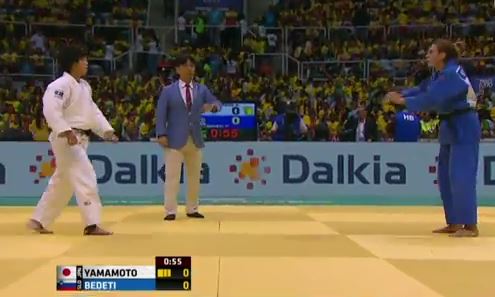
One example: In the woman's 57 kg  repechage match between the Japanese Anzu Yamamoto and  the Slovene  Vlora Bedeti, Yamamoto got her second penalty score when she was  more active than her opponent,  being all over her. In contrary Bedeti got not punished for being passive. I see here a discrimination based on the color of skin. There is no other explanation, unless  there was   a bribery issue. This judge "robbed" the Bronze medal from Yamamoto and gave it to Bedeti by punishing the Japanese 3 times straight with the penalty (shido score). In the last minutes he gave Bedeti 2 penalties pretending he was fair to both. No, he wasn't!

With 55 seconds left, Yamamoto was punished with three penalties for doing all the hardwork and going forward 
The athletes representing "poor" countries or those who have a different skin color than one "prefer", must  be way too strong and capable of making scores any judge  cannot deny, in order to win  surely. That means, they should always keep in mind  that they have a disadvantage and have no chance to win unless they overpower their opponent. Both in boxing and wrestling, "poor" athletes must dominate if they want to win. The K.O is the  guarantee for  winning in boxing, for example. I am positive that not one  judge can declare an unconscious "rich" boxer as the winner. Our trainers should keep this in mind all the time and prepare their athletes to make them superior to others if they want to see some success. Being evenly strong like  the world class athletes alone does not guarantee a thing. We must dominate to overcome this discrimination if we want to make names in the world level. Unfortunately the officials in the world sport organisations do not enough to put an end to this unacceptable attitude shown by some judges again and again, so we shouldn't expect anything better or any improvement in near future. If there is no will, there will be no change.
Until then let's keep pretending that  we all don't tolerate any kind of discrimination in  sports and that everything is fair and just.

Sunday, August 25, 2013

Chinese murder Mongolian herders

Chinese worker attack Mongolian herders
An another herder is killed by Chinese  workers.  Now, for those  who have no clue about these Mongolian herders, I must give an explanation here. We are talking about Mongolian nomads living in so called Inner Mongolia, a piece of territory used to belong once upon a time to Mongolia.  China has it annexed , with support from Russia and against the will of the native inhabitants- Mongolians, thus making them the minority nationals in China. Mongolian mainland was cut in three parts, and two smaller portions are now behind the border of proper Mongolia:  Inner Mongolia is included in  China and Buryat Mongolia in now part of Russia. Mainland Mongolia borders with Inner Mongolia (China) to  south, southeast and east, and with Buryat Mongolia (Russia) to  north.

Buryat Mongolia's territory (red, part of Russia)
Inner Mongolia (yellow border line, now part of China)


So, this incident happened in Inner Mongolia and we are talking about the  native Mongols living in that region, now part of China. This is the fifth murder committed by Han-Chinese against the Mongolian herders who suffer more and more from the Chinese migration and occupation in their lands. 
SMHRIC (Southern Mongolian Human Right Information Center) reported about this murder on its website. Let's first read about  what happened there:

One more Mongolian herder killed by the Chinese, defending his grazing land 
SMHRIC
August 20, 2013
New York

On August 19, 2013, around 5:30 pm local time, Mr.Bayanbaatar, a 58-year old Mongolian herder from Dalan-tsetseg village, Tohootai Gachaa (a Gachaa consists of several pastoral villages), Tug Sum (Sum is equivalent to township), Uushiin Banner of western Southern (Inner) Mongolia, was brutally beaten to death by Chinese railroad workers while he was defending his grazing land.  His son was severely injured. Several other herders were also beaten. Bayanbaatar's body was left in the Uushin Banner People's Hospital for cremation.

According to written communications received by the Southern Mongolian Human Rights Information Center (SMHRIC), several Chinese workers from China Railway Bureau No.23 started the brutal beating when Bayanbaatar and other herders protested the Railway Bureau's occupation of their grazing land without proper compensation. Arrogant and rude as shown in the pictures, the Chinese railroad workers not only threatened to kill the herders if they continued to protest but also sent some of their fellow workers to bring knives to carry out the killing. The local police arrived late to the scene, but reportedly refused to carry out any arrest  of the killer or other offenders.

"Our deep sorrow and sincere condolences to Mr.Bayanbaatar who was beaten to death by the Chinese railway workers from China Railway Bureau No.23 while defending his grazing land", posters, messages of condolences and pictures by Mongolian netizens spread quickly through major Chinese social media including  Renren, QQ, Tencent Weibo, Webchat and Sina Weibo before they were deleted.

Since 2010, at least five Mongolian herders including Mr.Bayanbaatar have lost their live at the hands of Chinese workers while defending their rights to their grazing lands as well as their right to maintain their traditional way of life.

In 2010, a Mongolian herder from Sobrog Sum of Bairin Right Banner was stabbed to death by Chinese from the  "Livestock Grazing Prohibition Team" ("jin mu dui" in Chinese), a special police task force set up by the Chinese Government to ban livestock grazing by Mongolian herders on their own grazing lands.

In May 2011, a Mongolian herder named Mergen from Shiliin Gol League was brutally run over by Chinese coal-hauling truck while he was defending his grazing land from coal miners.  His death sparked large-scale protests and demonstrations by Mongolian herders and students across Southern Mongolia.

In October 2011, a Mongolian herder named Zorigt from Huhtolgoi Gachaa, Uushin Banner of Ordos Municipality was killed by a Chinese oil transport truck as he tried to protect his grazing land from Chinese oil mining trucks.

In July 2013, an angry and desperate herder from Ongniud Banner of Ulaanhad Municipality committed suicide after stabbing and killing the head of the "Livestock Grazing Prohibition Team" and seriously injuring another official while defending his right to graze his livestock on his grazing land.

Becoming the largest coal and natural gas source in China and producing 95% of the world's rare earth supplies, Southern Mongolia has recently been named  "China's energy base".
Chinese mining giants Shenhua Coal and Chang Qing Oil as well as thousands  of private miners have rushed to Southern Mongolia chasing their fortune.  Grazing lands have been illegally occupied and opened up for mines. Herders have forcibly been removed from their land without adequate compensation and proper resettlement.

In response to this unprecedented level of destruction of their grazing lands, Mongolian herders are standing up to defend their right to pursue their livelihood and traditional way of life.
Hundreds of herders have been beaten, arrested and detained in clashes with the Chinese on an almost daily basis. In the latest such case, 13 Mongolian herders were arrested and detained last week in Ar Horchin Banner for protesting a Chinese gold mine's illegal occupation of their grazing land; hundreds of Mongolian herders stormed into the government building of Urad Middle Banner to carry out a mass sit-in a few  days ago.


An update on this case has been made by SMHRIC recently. More detailed information is given by the victim's daughter-in-law by phone. 

Central Government involved, family rejects negotiation

SMHRIC
August 22, 2013
New York

The Southern Mongolian Human Rights Information  Center (SMHRIC) has been closely monitoring the case. Additional pictures were received showing further details of beating that led to the herder's death.
In response to the Chinese authorities' denial on the cause of death as murder as reported on some news media, the SMHRIC was able to interview the victim's daughter-in-law Ms.Chyandmuun who provided further details and confirmed that her father-in-law was unquestionably  beaten to death.

Fearing possible large-scale demonstrations, the Chinese Central Government is directly managing the fall out from the incident.  An attempt is in progress to negotiate with the murdered herder's family, offering them 500000 yuan (approx. USD 82,000) to settle the case. The family members rejected any sort of negotiation and stated that "We Mongolians do not want and do not need any money. What we want is dignity and justice".
About 80 people including the family members and relatives of the victim have been placed under police custody in a funeral house near the Uushin Banner People's Hospital.
Reportedly an unknown number of Mongolian herders from the same area have been arrested yesterday on suspicion of possible unrest sparked by the case. The following is the full interview conducted over the phone by SMHRIC :

SMHRIC : Hi, this is the Southern Mongolian Human Rights Information Center, calling from the United States. We talked to Mr.Batchuluu yesterday about his father's unfortunate death. May we talk to him again?
Chyandmuun : Sorry, my husband is not available at this moment.

SMHRIC : We would like to obtain further details on your father-in-law's death. The Chinese authorities seem to be determined to deny the facts of the beating death of your father-in-law. They are claiming that he "possibly had some pre-existing heart problem". How credible is this claim?
Chyandmuun : My father-in-law was a very healthy man who had no health problem at all. He had no pre-existing medical conditions whatsoever. It is an undeniable fact that my father-in-law was beaten to death by the Chinese.

SMHRIC : We know it is difficult for you to recall the details of this tragic event. But, for the sake of clarity, is it possible for you to give us some details about how exactly the beating took place? Did the offenders use any weapons such as knives? How many of them were involved in the beating?
Chyandmuun : Although they claimed to kill us with knives, they didn't use any knife. My father-in-law was beaten to death by the Chinese who violently kicked and used their fists on him. Most of the beating was done by one man in a white shirt.

SMHRIC : One of the pictures shows that a man in white is holding his fists tight and carrying out the attack. In another picture, the same man was holding a big rock and targeting someone to hit.
Chyandmuun : Yes, exactly, he was the murderer. But, actually the big rock he threw didn't hit my father-in-law, it hit another herder who was lucky to narrowly escape with minor injuries.  My father-in-law collapsed under his fists. When my husband tried to help him stand up, he said he felt serious discomfort on his chest.
Unable to stand up, he fell on the ground again. My husband tried to rush to bring him to a hospital nearby.
But what was even more egregious was that the Chinese workers intentionally blocked our way and stopped us from taking him to the hospital for more than 30 minutes. It was clear that the killing was intentional, malicious and brutal.

SMHRIC : What was the Chinese workers' attitude toward you at the beginning of the incident?
Chyandmuun : Their attitude was very rude and arrogant. They seemed to have come for the purpose of carrying out a killing, not for construction.  They started using  their fists as soon as we started to protest their illegal occupation of our private road on our land.  Especially, the killer asked the other Chinese to bring a knife from his car. He said he would kill all the Mongolians one by one.

SMHRIC : What is the response from the government? Any word on prosecuting the murderer by the authorities? 
Chyandmuun : No, no word on the prosecution has ever been received. Instead, the government is holding all of us  hostage at the funeral house. We are about 80 people including all of our family members and relatives.  The entire funeral house is put under tight police surveillance, and we are not allowed to leave the funeral house. Our every single move is monitored closely. Our phones are tapped. Police are escorting us everywhere around the clock, even when we go to the toilet. We have completely lost our freedom here.
What the government is trying to do is to negotiate with us.  They said, they can give us 500,000 yuan (approx. USD 82,000). We said no negotiation, eye for an eye. The murderer must be brought to justice to be executed in front of our eyes.  We told them, unlike you Chinese we Mongolians do not measure human life with money.   We Mongolians do not want and do not need money. What we need is dignity and justice. The murderer who claimed to kill us Mongolians one by one must be executed, and the government must apologize publicly to the Mongolians in front of the eyes of the whole world.
Similar events are taking place too often and everywhere in Mongolian areas.  My father-in-law or my family is not the only victim. All Mongolians are victimized.

SMHRIC : You have mentioned that the government is trying to negotiate with your family. What department of what level of government is attempting to engage in the negotiation?
Chyandmuun : The government of Uushin Banner and the Central government. They told us that some special dispatches from the Central Government arrived here already to negotiate with us on behalf of the murderer. We do not engage in any type of negotiation.

SMHRIC : We learned that yesterday some other herders were arrested there. Is this arrest related to the case of your father-in-law? 
Chyandmuun : Yes, I heard that. Although I am not sure exactly how many herders were arrested, I know that they were herders from our Tug Sum. In terms of the possible connection, being Mongolian is enough for them to be subjected to arrest and questioning in relation to my father-in-law's case, fearing  possible unrest.

SMHRIC : Thank you very much for the further details on the case. We will continue to monitor events related to this case as it unfolds. 
Chyandmuun : Thank you for your concern and publicizing it to the world.


MY NOTE:  Even though those Mongols of Inner Mongolia are being considered as Chinese citizens, they are our brothers and sisters by blood and flesh, and that is why we care.  We, the Mongols living in Mongolia, condemn strongly this kind of brutal action by the Chinese against the Mongols, a minority in China, and demand immediate punishment of the killers. One could ask, how on earth the Chinese would expect any respect and  appreciation from the minorities in China, like the Mongols, Tibetans or Uighur, if they treat them  this way?  Such attitude and behavior on part of the Chinese toward the minority will cause nothing but hatred and resentment against Chinese. The Chinese will not only hated by those affected, but also the world society  dislikes their murderous  actions  as well.  Such hostile attitude, bullying and disrespect against the native Mongols and other minorities in that matter, will lead to nothing but  disgust and  antipathy. We hope that is not what Chinese people want.  We also hope that as a member of the world society, the Chinese care well about their reputation and standing among the world nations.  So, the conclusion is crystal clear:  Show some respect and  acceptance towards the minorities who have different life styles and own ways of existence. There is no other way to be respected and accepted by others than to respect and accept the other ones. 

Thursday, August 15, 2013

A tiny info-mosaic

It's been a while since my last post in June. So, what has  happened since then?  Here is a  list of some events which got the most attention:

N. Enkhbayar (former President of Mongolia)
- Former  President N. Enkhbayar got pardoned by the current President Elbegdorj. He flew to South Korea to get some treatment because  his health condition got worse after his  "dry" hunger strike in prison. He was sentenced to 2.6 years of prison for his abuse of power.

- Mongolian People's Party (MPP- former communist party)'s Conference is scheduled  on October 27 this year. MPP has been "knocked down"  5  times in a row, in  last elections, and they will discuss at their meeting how to stop this  downslide and make a come back. Major changes in party leader positions are expected.

- Oyutolgoi project has put on hold  its underground developments and sent its 2000 workers home, temporarily. It is not clear whether Rio Tinto uses it as a tool to "tease" the Mongolian Government and/or the Parliament, or was it because of the lack of financing the underground expansion  which is the key of reaching to the major deposits of this mine. It says, Mongolia  still has 22 disputes with Rio Tinto over Oyutolgoi - a world class copper and gold  mine in the south Gobi in Mongolia.

New Boeing 767-300 ER
- Mongolia has bought a brand new Boeing 767-300 ER. Two additional Boeing 737-800 will arrive in 2015.  Mongolian Airlines (MIAT) has recently opened a new line to Ereen city (China) and plan to open additional new routes.

- Some  former and current high ranking  Government officials, and an MP are involved in money laundering crimes, bribery and either awaiting their cases been  decided at the court, or sent already to prison. All of them are MPP members since this party ruled in the last 8 years, making this country one of the most corrupt in the world.

Horse racing
- This year's Naadam fest was no exclusion with regards to losing  of children's lives during the horse racing. Two children have lost their lives after falling off their horses while racing. Few escaped with different level of injuries. The jockeys in Mongolian horse races are exclusively children ages of from  7 and up. This has been a big issue among Mongolians for some time, but it couldn't be solved yet. The supporters (race horse owners, mostly riches) say it should be kept as is it because it's been a tradition (a point which is disputable), and opponents argue we should stop using the children as jockeys.

Brown stallion secured an SUV for his owner
A Naadam is a traditional festival  where men compete in three competitions: horse racing, traditional wrestling and archery. There are lot of drinking and eating involved, and celebrated nationwide. Officially it lasts for three days but at the country sides it continues a bit longer. At the "Grand speed" (in Mongolian: Ikh Hurd) after Naadam,  the winner was awarded  with an SUV (Toyota Land Cruiser) and the next runner-ups  from second place to fifth place received  20 mil, 16 mil., 14 mil., and 10 million MNT respectively. (Mongolian Tugrik-MNT and USD rate is currently  1568 : 1 ). The best  stallions and horses of 5 years and up, from around the country compete in 2 categories in  distances  of 22 km and 24 km.  

Horse rider parade (with 11500 participants)
- Mongolians are being  addicted to beat Guinness records any way they possibly can. It might look harmless than a marijuana addiction but it did cost a child's life during the recent event- a  race of 4249  horses (18 km = 11 miles).   Organized by the Mongolian  Federation of Horse Racing Sports  and Trainers  (MFHRST) ,  this race was officially registered as  world record by Guinness officials who came to Mongolia and witnessed the event.  MFHRST  has also organized a parade  of 11 thousand horse riders, a something that had  not an important point except to show the world that Mongolia has lot of horses and we are a nation  proud of our  horses.